One of the great joys of the art fairs is to be exposed to galleries from around the country and world (it is also a tragedy—to discover a great gallery that isn’t a subway ride away!). In this case, I must find a good reason to go to Houston to see Inman Gallery and the work of Dario Robleto. His body of work that was on view at the ADAA Art Show (February 28 – March 3, 2019), Small Crafts on the Sisyphean Seas, is rife with beautiful tension and complexity.
I was drawn into Inman Gallery’s booth by Robleto’s intricate collages, which reminded me of Victorian curio cabinets. I engaged the gallery owner, Kerry Inman, in a fascinating conversation about the work, which indeed has its inspiration from the Victorian impulse to collect, categorize, arrange and display. Given that man-made climate change is endangering our planet and oceans to a catastrophic point, there is an ominous undertone to the preservationist quality of the work (will these species exist by the end of the century?), but the pleasing, decorative compositions soften the more sardonic implications of the piece. Robleto’s tightly organized tableaus at once poke fun at humans’ hubristic attempt to control and dominate our natural environment, but at the same time, we marvel at Robleto’s (read: Man’s) monk-like patience and ability to create the intricate details of the work (isn’t this why we’re at the top of the food chain?).
Dario Robleto, The Naturalist’s Lament, 2018. Cut paper, various cut and polished seashells, urchin spines, green tusks, squilla claws, mushroom coral, colored powder pigments and beads, colored crushed glass and wire, plastic domes, prints on paper, colored and mirrored Plexiglas, foam core, glue, frame. Image by Emily Casden, courtesy of Inman Gallery, Houston.Dario Robleto, The Naturalist’s Lament, 2018, detail. Image courtesy of Inman Gallery, Houston.
But my mind was truly blown when Kerry told me about Robleto’s artist residency with the SETI Institute. That’s right: the Search for Extra Terrestrial Intelligence Institute has an artist-in-residence program, to pose the incredible question: what if mathematics is not the universal (literally) language with which to communicate with alien life? What if we must communicate with E.T. visually, aesthetically? All art seeks to communicate in some way, but this is the first art I have experienced that seeks empathy with an alien species.
Dario Robleto, Small Crafts on Sisyphean Seas, 2017-2018. Cut and polished nautilus shells, various cut and polished seashells, various urchin spines and teeth, mushroom coral, green and white tusks, squilla claws, butterfly wings, colored pigments and beads, colored crushed glass and glitter, dyed mica flakes, pearlescent paint, cut paper, acrylic domes, brass rods, colored mirrored Plexiglas, glue, maple. Image by Emily Casden, courtesy of Inman Gallery, Houston.
At the core of his cross-species aesthetic program, Robleto focuses on the shell, particularly the nautilus: not only is it one of the oldest biological forms on our planet, but it does contain math in the golden ratio of its construction. Now we (read: Man) marvel at the power of Nature, and find empathy with Nature’s ability to create beauty as we do. The artful symmetry of the shell has made it a favorite decorative object for humans for millennia, for use in jewelry, ritual objects, and even currency. These intergalactic offerings encompass biology, history/time, mathematics, beauty and cultural significance–to quote the gallery’s press release, they perform “archival and emotional communication.” Any alien who would reject such a gift clearly has no taste at all.
Dario Robleto, Small Crafts on Sisyphean Seas, 2017-2018, detail. Image courtesy of Inman Gallery, HoustonDario Robleto, Small Crafts on Sisyphean Seas, 2017-2018, detail. Image courtesy of Inman Gallery, Houston.
In May of 2015 I had the great privilege of visiting Cuba for the Havana Biennial, about a month before President Barack Obama announced a restitution of diplomacy with Cuba. Just a few months prior, in April 2015, Obama and Raúl Castro had made history when the U.S. and Cuban leaders met for the first time in fifty years; just a few weeks later, I was eager to see what Cubans made of this historic moment.
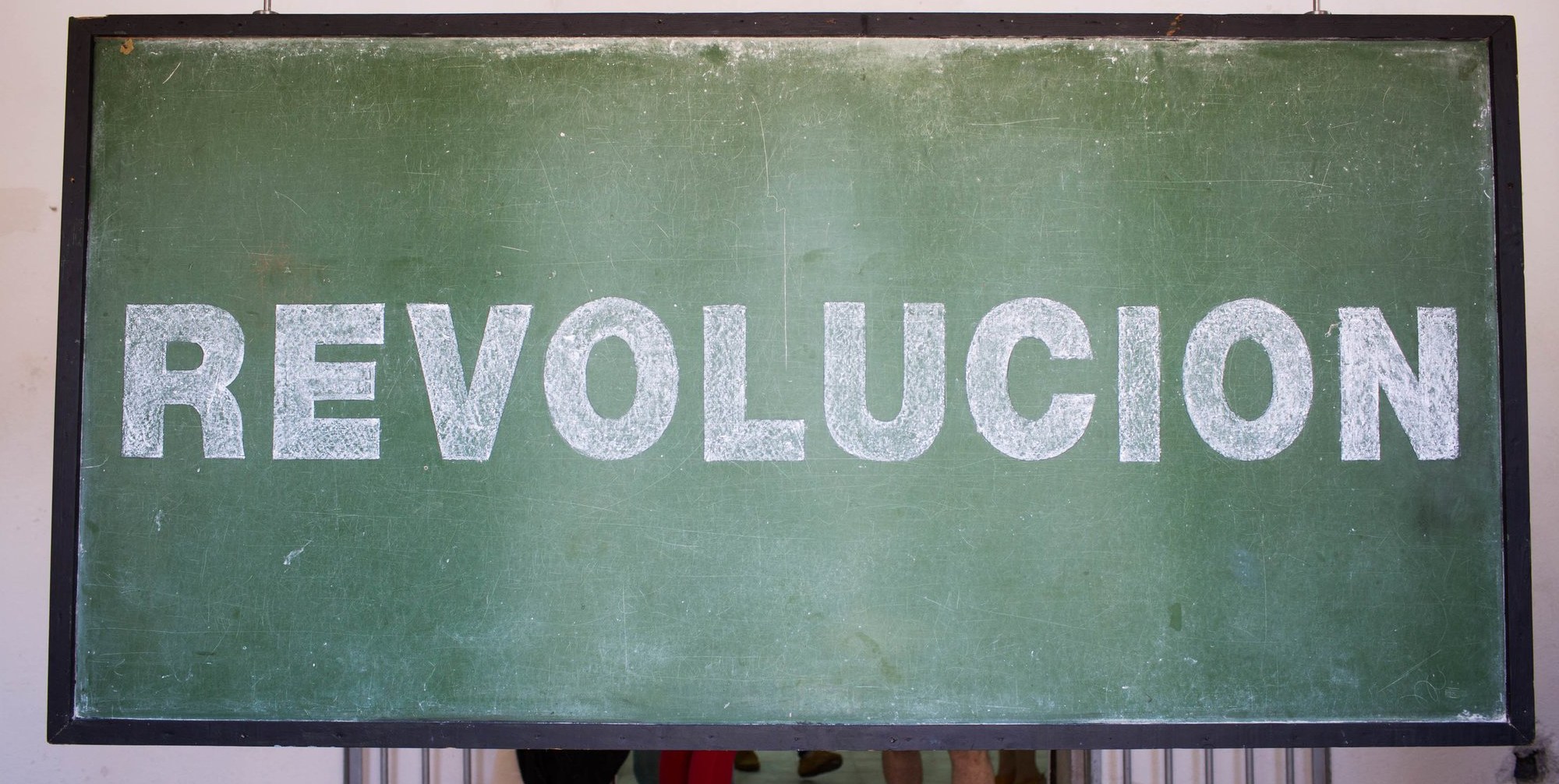
Lidzie Alvisa, Revolucion at the 2015 Havana Biennial. Image courtesy of in-cubadora.org
We were greeted at José Martí International Airport by our government-assigned tour guide, Mirelys. On the bus to our hotel she expressed joy at the thawing relations, and noted that Cubans were eager to embrace Americans. But while our bus idled at a stoplight, I looked out the window to a billboard with a morbid picture of a noose, and text that read in Spanish, “the American embargo is the noose around Cuba’s neck.” I pointed at the sign and asked Mirelys if indeed Cuba was warming up to the U.S.; she provided a nonsensical and almost certainly government-fed response that Cuban-American businessmen in Miami had paid for that billboard. Such Cold War emblems were at odds with the generally warm reception we received as tourists; I could tell this place would be rich with fascinating contradictions.
Arlés del Río’s installation at the 2015 Havana Biennial. Image courtesy of the New York Times
Such paradoxes were only magnified on the grounds of the Havana Biennial. I was impressed and surprised by the volume of politically loaded art in a state-authorized art fair. Artist Lidzie Alvisa, a Havana native, departed from her photographic explorations of the body to install a green chalkboard with the word “Revolucion,” erased and rewritten several times. Cuban artist Arlés del Río hung colorful, elongated snorkel tubes from the ceiling, like plastic stalactites; the snorkels a symbol of leisure, but also tools for swimming underwater, undetected by those policing the shores. Another artist (whose name, sadly, I did not record and cannot locate in Google searches) presented a simple photograph of the ocean, with a black light dangling nearby. When a viewer raised the black light to the image, the ghostly letters of at least a hundred names appeared—the names of those who had died trying to flee the island in times of crisis. Perhaps the biggest illogicality of all was learning that the artist Kcho, whose frequent use of boats conjures both Cuba’s fishing economy and the desperate exodus of its citizens, was one of Fidel Castro’s favorite artists. (As a symbol of the island’s physical and socio-political isolation, the ocean is an important and consistent theme for Cuban artists.)
Kcho (Alexis Leyva Machado), The Conversation, installation at the 2012 Havana Biennial. Image courtesy of the New York Times
But not all dissident art was tolerated. Performance artist Tania Bruguera has frequently been harassed and arrested in the past twenty years, and her “artivism” was under careful watch of the Cuban government. For the first half of 2015, Bruguera had been forbidden to leave Cuba for “disturbing the public order,” and so naturally, she opened the biennial with a public reading of Hannah Arendt’s 1951 The Origins of Totalitarianism, which landed her another arrest. (Unsurprisingly, the itinerary of my government-approved guided tour kept us away from Bruguera’s performances.)
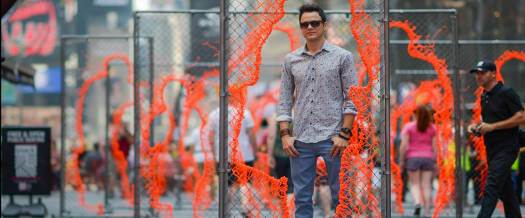
Despite such unsettling instances of censorship, and despite the fact that Mirelys’s rosy assessment of Cuban life didn’t always line up with what we observed around us, I would say that in 2015 there was hope among young Cubans that real change was coming to Cuban society. For artists, an influx of curious (and well-heeled) American collectors was a good thing. In fact, Cuban artists were already benefiting from the global art market: they were exhibiting abroad at international galleries and art fairs; they were permitted to travel more freely than the average citizen; and they were making real money beyond the modest income afforded to them in the closed and tightly regulated economy of their native country. Arlés del Río, for instance, has gallery representation in Florida, and exhibited an installation in Times Square in 2014, among other international shows. But recent developments seem to have halted this progress for the creative community in Cuba.
Arlés del Río with his Times Square installation Fly Away in 2014. Image courtesy of Times Square Arts
First, there was the issue of the cancellation of the 2018 Havana Biennial (since 1994 the event has in fact been triennial). News outlets reported that the biennial was postponed due to severe damage caused by Hurricane Irma in September 2017, which did indeed have a serious impact on the country’s already fragile infrastructure. But as some astutely noted, the 2018 Biennial was also scheduled to follow on the heels of Cuba’s biggest political event in nearly half a century: a transfer of power to a non-Castro family member, Miguel Diaz-Canel, who was handpicked by eighty-five-year-old Raúl Castro to take over as president. In such a delicate time of political transition, the last thing the government needed was a Tania Bruguera performance to disrupt the state’s broadcasted socio-political “unity.”
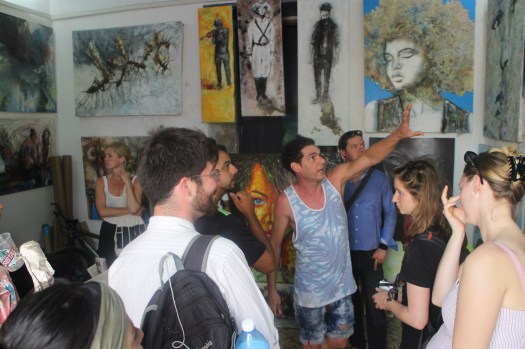
In light of the cancellation of the 2018 Biennial, a group of artists decided to put together an independent art festival—the “Alternative 00 Havana Biennial,” the first artistic event organized without the involvement of the state, which ran in May of 2018. The various artistic events took place in artists’ homes, studios, and other found spaces. Hyperallergic reported that the Alternative Biennial was approved by the Cuban government, but several artists reported harassment and, later, fines and other penalties for participating. The Havana Times published the following dismissive response from state-led artistic organizations:
“Very few people have joined this abomination of a Biennial, without any important works mostly, who, maliciously or confused, are after the fame that this mercenary platform and overexposure on social media can give them. They have announced that it will be held at non-important venues and is only a failed attempt to attack the government’s cultural policy, where quite a few of them are skirting with the law. They want to mislead artists so that they use their studios, which have institutional support, so as to provoke the government.”
Exhibition in the studio of Walfrido Valera during the 2018 Alternative 00 Biennial in Havana. Image courtesy of Hyperallergic
Now, at the close of 2018, the Cuban government put into effect a more direct and antagonistic assault on artistic freedom of expression: Decree 349, a law that regulates the subject matter and display of art in Cuba. The law requires that artists must obtain government approval before performing or displaying their art, and certain taboo subjects—such as sexually explicit language or addressing racial discrimination—are forbidden. Government authorities are empowered to cancel shows and confiscate property, and revoke artists’ license if they deem it necessary.
The law has elicited an outpouring of rage and remonstration: 250 artists signed a letter in protest, and met with cultural officials to address the danger of such censorship. Tania Bruguera has reported that she is under constant surveillance by the state, and other artists have organized demonstrations against the new draconian measures. But few have any faith that their concerns will be addressed in a meaningful way. One exiled Cuban artist told the Wall Street Journalthat the decree was in direct response to the new freedom and wealth that artists were enjoying: “The purpose of the decree is to regulate a new world: private businesses, art galleries, people working from their homes. The alarm went off because it is a sector that is not under state control.”
What will the 2019 Havana Biennial look like under Decree 349? Will it apply to just Cuban artists, or international artists as well? If the latter, surely most international artists will not tolerate such cultural regulation, and will pull out of the biennial altogether. This new crackdown on the arts is, in a word, awful. The world must do its part to pressure the Cuban government to lift this restrictive law.
To learn more about the decree, as well as a brief history of censorship in Cuba, read this New York Timespiece.
Artist and activist Tania Bruguera, performing Self-Sabotage in 2009. Image courtesy of W Magazine
“You can’t have a golden age without gold,” someone quips in the recent HBO documentary on the billion-dollar art industry, The Price of Everything. To this, New York Times film critic A.O. Scott comments, “by that standard we are currently in the epoch of platinum.”
Between the headline-grabbing sales of hundred-million Basquiats and Hockneys and da Vincis; the closure of small and midsize galleries, competing in the shadow of powerhouse galleries; and a collecting class that just seems to keep accumulating more wealth, the reputation of the art world has become one of bloat and excess. In this current atmosphere, one would be forgiven for assuming that one needs to be a millionaire to afford to buy art. But as I often remind people, there is good art in this town at far more affordable prices. And while we can always celebrate the success of artists who deserve critical and popular acclaim, it is also an important to support emerging artists, so the art market can stay strong from the ground up.
That is why I am taking a moment today to introduce you to the Prince Street Gallery and its current solo show, Lost and Found, works by Siu Wong Camac. The Prince Street Gallery began in 1970 as an artists’ collective called the Alliance of Figurative Artists; over the years they expanded their mission to include abstract as well as figurative art, and in 2001 the collective moved to their Chelsea location at 530 West 25th Street (but maintained their downtown roots by keeping the Prince Street name). In addition to shows of their represented artists, the gallery hosts juried exhibitions with some past notable jurors, including artists Philip Pearlstein, Yvonne Jacquette, and Susanna Coffey.
Siu Wong Camac, a member of the collective, currently has a solo show of her recent work on view at the Chelsea space through February 23. I happened upon the show while checking out some other gallery openings in the same building, and I was immediately drawn to the work for its vibrant palette, deft brushwork, and palpable and evocative moods. Finding inspiration from printed matter, found photos, films and stories, Wong Camac explores concepts of nostalgia and memory, capturing “recollections lost, then found:” the tone of the paintings range from warm innocence, to dreamy whimsy, to occasional unease and apprehension. Wong Camac’s facile ability to capture a spectrum of narration, sensation and emotion is a testament to her empathetic skills as an artist.
And now for the icing on the cake: all the works in the show range in value from $800–$3,400. Well worth the value, in my opinion! Support emerging artists and check out Lost & Found, on view at Prince Street Gallery now through February 23 (530 West 25th Street, 4th floor).
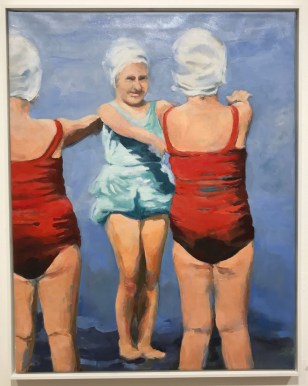
Works by Siu Wong Camac: So I Changed My Name, oil on wood, 2018; Who Needs Ken, oil on canvas, 2018; The Skaters, mixed media on wood panel, 2018; The Fields, mixed media on canvas, 2015; Three’s a Crowd, oil on canvas, 2018






 Avant-Garde