Spring 2019 Auction Roundup: a ‘KAWS’ for cheer?

Let’s get one thing straight: any market that generates over $7 billion a year is doing fine. But, as has been the case the past few years, there’s mixed results reflected in the auction seasons: there are statistics we can examine in the spring 2019 sales that speak to bullish growth, enthusiasm and collector confidence; and there are other statistics that speak to a slowly waning art market. This fickle data requires collectors, advisors and appraisers to pay close attention to the nuances of each auction, and the fluctuations in each artist’s own market.

The nearly 2,000 lots offered this past May by the three major houses (Christie’s, Sotheby’s, and Phillips) grossed just over $2 billion; the equivalent sales last May brought in more than $2.8 billion—a gloomy decline. Another ominous statistic: Sotheby’s, the only publicly traded auction house of the three major houses, reported a 2018 income of $108.6 million, down from $118.8 million in 2017. For the first quarter of 2019, the auction house declared a loss of $7.1 million—worse than its $6.5 million loss for the equivalent period last year. One can perhaps attribute Sotheby’s decline to poor business decisions or structural issues, resulting in their recent decision to sell the company back to private hands for $3.7 billion. But one wonders if this regression is reflective of the secondary market as a whole (as privately held entities, Christie’s and Phillips do not report their profits and losses).

Another interesting fact: the number of guaranteed lots declined at both Christie’s and Sotheby’s from this time last year. In his New York Times preview of the spring sales, Scott Reyburn noted that this reflects seller confidence in the market; that these sellers don’t need the guarantees, and are confident enough to take on the risk that the good ol’ fashion auction model is all about. But seen another way: could the lack of guarantees reflect hesitation on the part of third-party guarantors—including the (possibly cash-strapped) auction houses themselves?

When we start to break down the sales themselves, the statistics get more nuanced. The “less good” news first: the Impressionist and Modern market generally continues to slow. Christie’s and Sotheby’s New York Imp and Mod day sales each sold below their aggregate estimates, respectively selling only 72% of their lots. Sotheby’s New York’s Imp and Mod evening sale came in just under $350 million, with the lion’s share of the revenue coming from the highlight of the spring season: a spectacular, luminous painting from Claude Monet’s haystacks series, which sold for $110.7 million—the new record for any Impressionist work at auction.
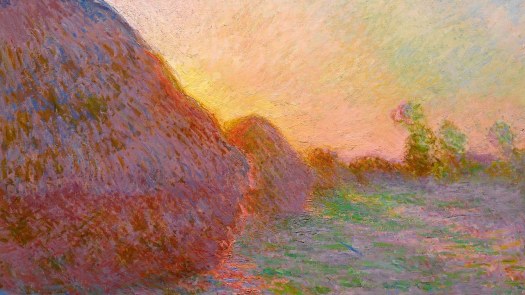
Monet Haystacks
Claude Monet, Meules, 1890, sold for $110.7 million at Sotheby’s, setting the record for any Impressionist work.

Yet despite the record-setting Monet, and a general sell through rate of 91%, other statistics from the Sotheby’s evening sale paint a different picture: twenty-five lots (nearly half of the offerings) sold below their low estimates, and some highlight works failed to sell at all, such as William Bouguereau’s La Jeunesse de Bacchus (1884), which stalled at $18 million, below its $25 million low estimate. And while this recent Imp and Mod evening sale did top Sotheby’s equivalent sale from 2018 ($318 million), both auctions relied heavily on the income of one major masterpiece (in 2018, half of the revenue of the evening sale came from Amedeo Modigliani’s $157 million Nu couché sur le côte gauche. As any business owner (myself included) will tell you: it’s never healthy to have your income so unevenly reliant on one source.
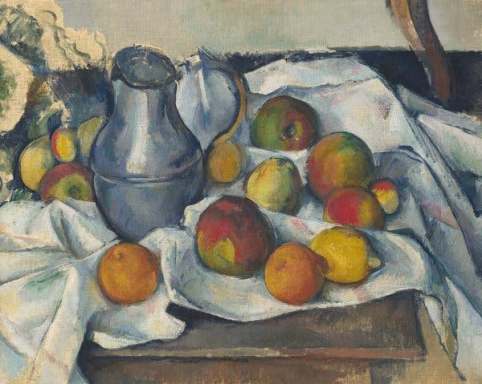
Cezanne Still Life
Paul Cézanne, Bouilloire et Fruits (Pitcher and Fruit), c. 1880s, sold at Christie’s for $59.3 million.

Speaking of blue-chip masterpieces: Christie’s Imp and Mod New York evening sale reached nearly $400 million ($50 million more than Sotheby’s), thanks in large part to the esteemed collection of the late Condé Nast juggernaut S.I. Newhouse, who passed away in 2017. Five artists alone accounted for more than $100 million of the Estate’s sales, including a $40 million Van Gogh landscape, and a Cézanne still life that was famously stolen in the 1970s and recovered in 1999, when Newhouse bought it at auction for $29.5 million. In their May sale, Christie’s sold it for $59.3 million.

As has been the case for many years, the news is better for the Postwar and Contemporary sales: the total sales for the three major houses was $1.214 billion. The gross revenue for the evening sales was $981 million, up 6.6% from the same sales last May. According to Artsy, this spring’s evening sales results were the biggest week for P&C auctions since November 2017 (which was greatly skewed by the $450 million sale of Leonardo da Vinci’s Salvator Mundi), and the best spring sales result since May 2015.

Koons - 1986 Rabbit
Jeff Koons’s Rabbit, 1986, broke David Hockney’s auction record for a living artist when it sold for $91.1 million at Christie’s.

Love him or hate him, the big headline-grabber of the week was Jeff Koons, whose Rabbit (1986) broke David Hockney’s recent auction record for a living artist when it sold for $91.1 million at Christie’s (Christie’s increase in buyer’s fees, introduced February 1, just tipped it past Hockney’s $90.2 million record). This work was also from the collection of S.I. Newhouse, and purchased by art dealer Robert E. Mnuchin on behalf of a client.

Bourgeois - 1997 Spider
Louise Bourgeois, Spider, 1996-97, sold for $32.1 million, a new record for the artist.

The art market trend–or correction–for works by women and artists of color continued: Louise Bourgeois’s massive Spider sculpture (1996-97) sold in Christie’s evening sale for $32.1 million—a world record for the artist, and a new record for a contemporary sculpture by a female artist. If artist Dana Schutz’s market felt any fallout following the controversy around her Emmett Till painting in the 2017 Whitney Biennial, it appears to have recovered, with two back-to-back auction records: her 2009 painting Signing set a record of $980,000 at Phillips, only to be shattered a few hours later at Sotheby’s when Civil Planning (2004) burst past its $400,000 high estimate to sell for $2.42 million (backed by an irrevocable bid).

Other notable sales by women and/or artists of color this spring included British artist Cecily Brown’s Confessions of a Window Cleaner, which sold for $3.62 million at Sotheby’s New York evening sale, and British-Ghanaian painter Lynette Yiadom-Boakye’s Leave a Brick Under the Maple (2015), sold for 795,000 GBP (about $1 million) at Phillips London, almost double its high estimate. The latter’s market may be benefitting from her inclusion at the Ghanaian pavilion at this year’s Venice Biennale, as well as a forthcoming retrospective at the Tate Britain next year.
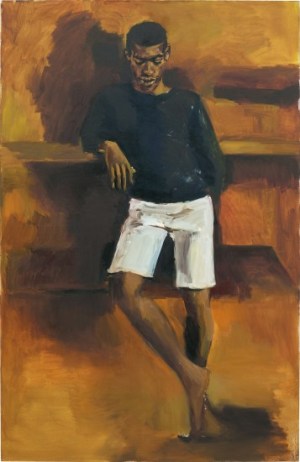
Yiadom-Boakye Leave a Brick Under the Maple
Lynette Yiadom-Boakye’s Leave a Brick Under the Maple (2015), sold for 795,000 GBP (about $1 million)

A record was also set for Toyin Ojih Odutola’s Compound Leaf, a self-portrait of the Nigerian-American on paper, which brought 471,000 GBP ($597,000) at Phillips London, well above its high estimate of 150,000 GBP ($191,000). And Tschabalala Self, the young African-American artist currently in residence at the Studio Museum in Harlem, set a new record when dozens of bidders competed for her 2015 collage Out of Body, ultimately selling for 371,250 GBP ($415,000).

Tschabalala - Out of Body
Tschabalala Self, Out of Body, 2015 (detail), broke a record for the young artist when it sold for 371,250 GBP ($415,000) at Christie’s.

It is remarkable that such recent works by young, trending artists are already coming up for auction, as galleries—and artists—struggle to keep up with the demand for fresh work. Some galleries have waiting lists for their hottest artists, and sellers are clearly willing to bypass galleries and put their works directly onto the secondary market, bringing prices that rival or even exceed gallery prices. Collectors are sometimes flipping their purchases after only a few a years: the seller of Odutola’s aforementioned Compound Leaf only acquired it in 2017, and a collector who bought Barkley L. Hendricks’s Yocks (1975) for $942,500 in May 2017, sold it this season for $3.74 million (against an estimate of $900–$1.2 million). This also speaks, however, to a still volatile and uncertain landscape for young artists who are not market-tested, and I urge collectors to make educated and measured decisions; we can learn lessons from artists like Jacob Kassay, whose auction market exploded rapidly between 2011–2013, and deflated just as quickly.
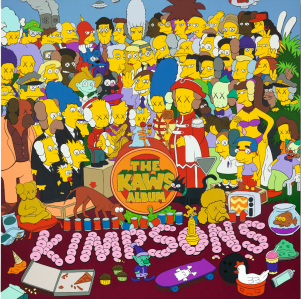
KAWS album.png
KAWS, The KAWS Album painting, 2005, sold at Sotheby’s Hong Kong for $14.8 million

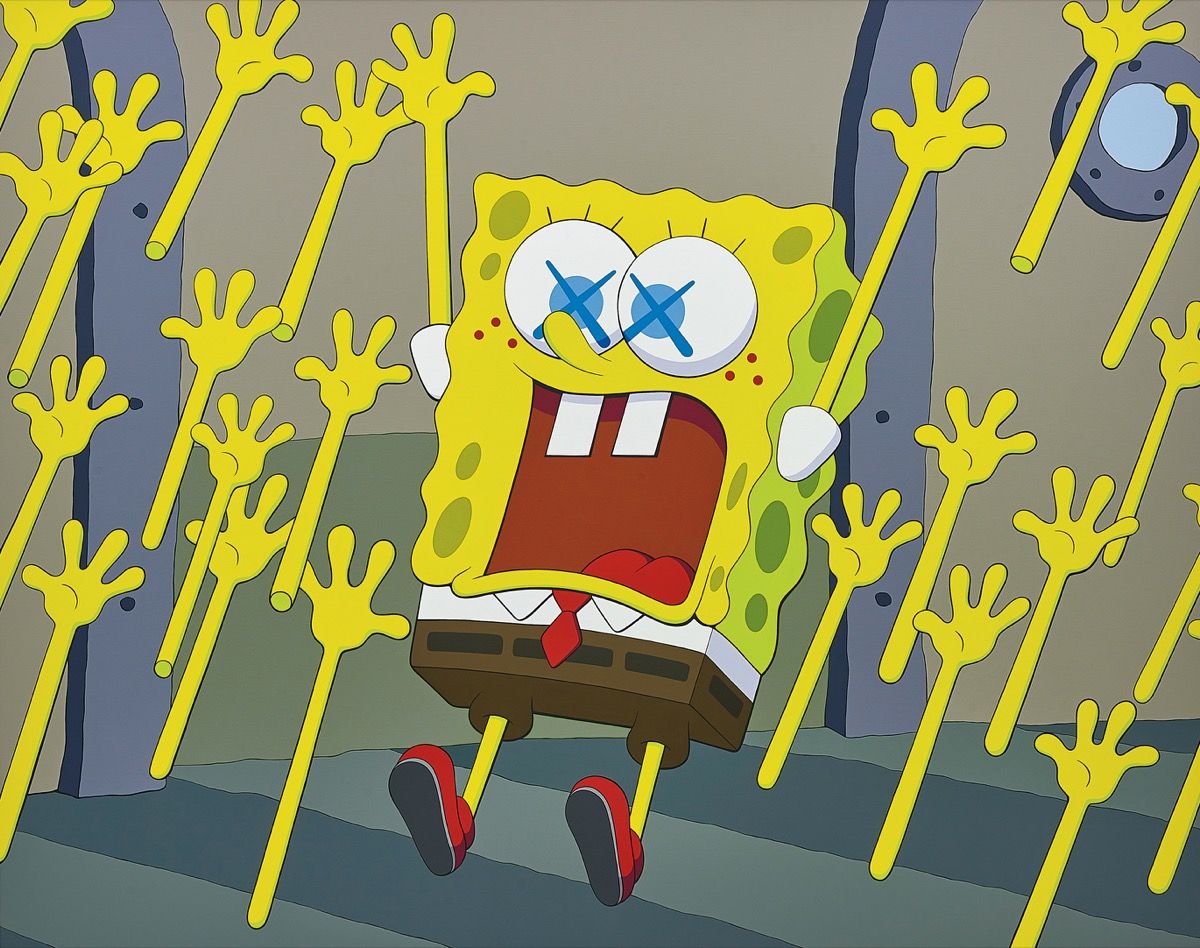
The other much-discussed winner of the spring sales was the street artist known as KAWS (aka Brian Donnelly). KAWS has not usually been taken seriously by critics, but his Instagram-friendly and accessible art has bypassed the usual market trajectory of artistic success (i.e. through critics and curators); Scott Nussbaum, head of 20th century and contemporary art at Phillips, especially credits a young, emerging class of collectors from Asia for boosting KAWS’s market. Following a whopping $14.8 million sale at Sotheby’s Hong Kong this spring for The KAWS Album (2005)—a parody of the Beatles’ famous Sargent Pepper’s Lonely Hearts Club Band album cover, with characters from The Simpsons—for the first time, all three major houses simultaneously included works by KAWS in their sales (19 works total). In these recent auctions, KAWS’s pieces continuously surpassed their estimates, including 2012’s The Walk Home, a large painting featuring SpongeBob SquarePants which sold at Phillips for an impressive $6 million, 10 times its low estimate of $600,000–a ‘KAWS’ for celebration (sorry, I couldn’t help myself). We’ll see what the fall sales have in store for him and the rest of the P&C market.

Until the next market report!

KAWS - The Walk Home
KAWS, The Walk Home, 2012, recently sold for $6 million at Phillips.

Spring Art Fair Highlights: the Armory Show

It’s the most wonderful time of the year! The spring art fairs are like Christmas for the art world—a belated and much-needed Christmas in March to pull us out of our winter blues. “Armory Week,” as it has come to be called, is a cultural smorgasbord of art fairs, parties, openings, panel talks, lectures, and performances that happen around the city. As you can imagine, there’s so much to pack in a few days that I do not have the time to write reviews in real-time (I can’t even get to all of the fairs and events I want to go to!), but I have, in a series of posts, covered some highlights and personal favorites that I saw at the venues I was able to cover. Check out my other posts for highlights from the ADAA Art Show, Spring/Break and Scope.

Armory Show

The Armory Show got off to a rocky start this year: one week prior to opening, the fair organizers discovered that Pier 92 was structurally unsound, causing a last-minute call to postpone the Volta satellite fair that would have been at Pier 90, and move one-third of the Armory exhibitors over to that space. Despite the snafu, the art was generally strong at the twenty-fifth presentation of the Armory Show. Once again, I didn’t get to see everything, and there are too many great works to address in one blog post, but I shall highlight a few personal favorites.

Gustavo Diaz
Gustavo Díaz, Variaciones sobre un bosque hipotético previo a la Gran Bifurcación – Modelo 002/ Era Prearbolítica,” 2019. Cut out paper. Photo by Emily Casden, courtesy of Sicardi Ayers Bacino, Houston.
Gustavo Díaz Cut Out Sculpture
Gustavo Díaz, work displayed at 2018 Armory Show.

I was delighted to see again the work of Gustavo Díaz, the Argentine-born artist who constructs incredibly intricate and delicate worlds in cut-out paper. I became enamored with his work at the 2018 Armory show, in which his gallery Sicardi Ayers Bacino displayed some of his miniature sculptural cities. On view for the 2019 edition, SAB showed Díaz’s wall-hung works: webs of cut paper that magnificently toe the line of man-made construction and something topographical or organic, like an ancient, skeletal cross-section of an anthill. The scale and method of construction (hand-cut, I believe) is technically astounding.

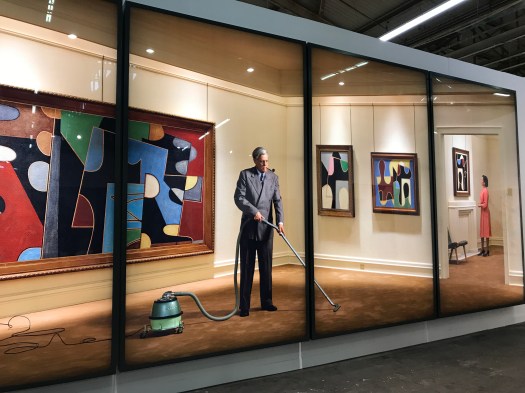
Moving along through the show, I loved the monumental (and difficult to photograph in its entirety) 2018 lightbox installation by Rodney Graham, Vacuuming the Gallery, 1949, apparently inspired by a vintage photograph of art dealer Samuel Kootz smoking a pipe in his gallery. The artist upends the airs of the art world, as well as gender stereotypes, in the cheeky tableau. The classic mid-century vacuum also conjured the image of Richard Hamilton’s 1956 collage, Just What is it that Makes Today’s Homes so Different, so Appealing?

Rodney Graham Vacuuming
Rodney Graham, Vacuuming the Gallery, 1949, 2018, monumental lightbox installation. Photo by Emily Casden, courtesy of 303 Gallery, New York.

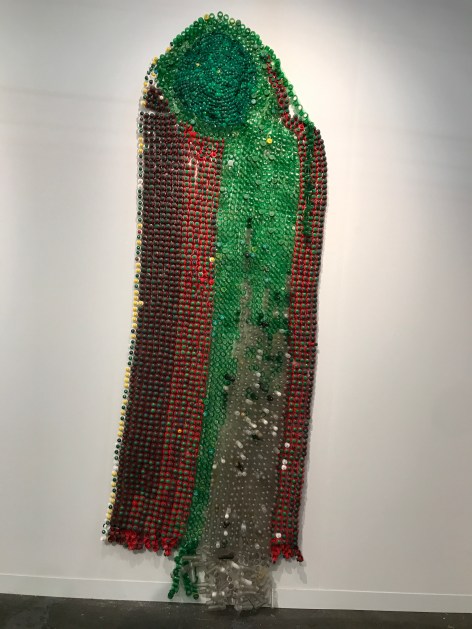
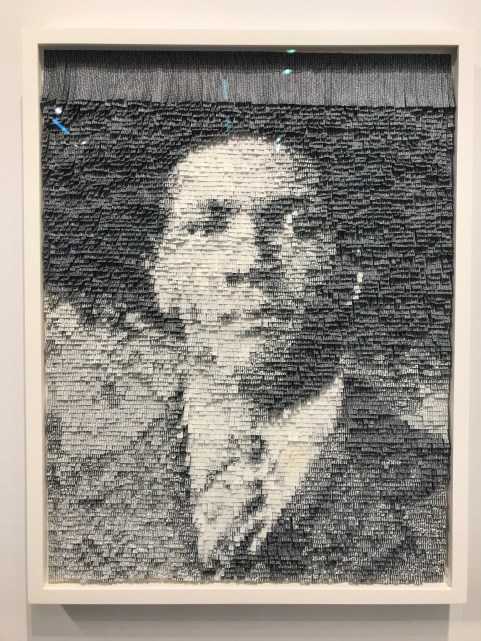
Like most visitors taking in the display of recycled plastic tapestries at Nicodim Gallery, my first thought was that El Anatsui was back in action (according to his own website, he hasn’t really had a group or solo show since 2016). But the gallerist informed us it was the work of newcomer Moffat Takadiwa, a young Zimbabwean artist. The themes of Takadiwa’s sculptures share many of the same concerns as Anatsui—reflections on consumerism, waste, colonialism and the environment—but are satisfying works in their own right, and surely more affordable than his well-established predecessor.

Moffat Takadiwa Sculpture
Moffat Takadiwa, Bottled Water, 2019, found blow molding pre-forms, plastic bottle caps, cuttings. Photo by Emily Casden, courtesy of Nicodim Gallery, Los Angeles and Bucharest.
Florine Démosthène installation shot
Florine Démosthène, installation view of her works on paper at Mariane Ibrahim Gallery at the Armory Show. Photo by Emily Casden, courtesy of Mariane Ibrahim Gallery, Seattle.

I think I have a crush on Mariane Ibrahim. The young gallerist, who has been based in Seattle but will be relocating to Chicago in 2019, has been killing it at the art fairs, promoting the work of some excellent talent from Africa and the African Diaspora. Her monographic display of glittering works on paper by Florine Démosthène sold out on the first day at $7,000 a pop—a total steal in my opinion.

One of my favorite sculptures of the fair was Alan Rath’s Yet Again (2017) at Bryce Wolkowitz Gallery, a dynamic pair of swinging arms resembling something sentient, like birds or snakes, engaged in a mating ritual. The artist wrote a code for the kinetic sculpture in which the movements of each arm is random, making each movement and interaction between the two unique. Photographs do not do it justice—click on my short video clip below for a taste of this dancing, flirtatious piece.

Below are just a few more works that I enjoyed—some by established artists, some by emerging artists. I wish there was time and space enough to discuss them all—if you’d like to discuss anything, feel free to leave a comment or email me with questions!

Love the vibrant palette of this Lee Mullican painting. It feels so much fresh and contemporary, but was painted over fifty years ago!

Lee Mullican Untitled 1965
Lee Mullican (1919-1998), Untitled, 1965, Oil on canvas. Photo by Emily Casden, courtesy of James Cohan Gallery, New York.

The artist Michael Sailstorfer cultivated a beehive inside the concrete base in the picture below; he then used the hive to create a mold to cast these delicate bronzes. He went through several attempts, and only saved a few as satisfactory for sale.

Sailstorfer bronze
Michael Sailstorfer, Kopf und Körper Marzahn 02, 2017, bronze and concrete. Photo by Emily Casden, courtesy of Proyectos Monclova, Mexico City.

Brothers Jake & Dinos Chapman’s sardonic revision of Goya’s Disasters of War etchings, entitled The Disasters of Yoga, (an anagram of Goya), is wonderful. The violence that is obscured and denied by the glitter is, instead, present in the brothers’ bronze sculptures of suicide vests nearby (not pictured). Apologies I couldn’t get a clear shot of the whole installation together, but see some details from the Yoga series below.

Chapman Disasters of Yoga
Jake and Dinos Chapman, The Disasters of Yoga, 2017, set of 80 reworked Goya etchings from The Disaster of War series, with glitter. Below: two details. Photos by Emily Casden, courtesy of Blaine Southern Gallery, London.

IMG_5467  IMG_5468

Below, a few offerings from the excellent Yossi Milo gallery:

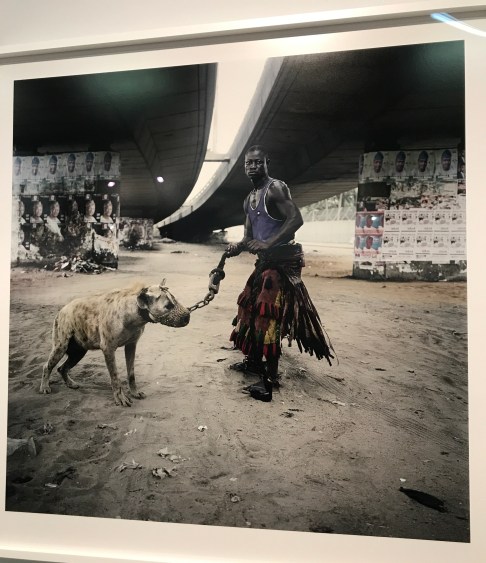
Pieter Hugo Hyena and Other Men
Pieter Hugo, From the series The Hyena and Other Men, Digital C-Print, from an edition of 9. Photo by Emily Casden, courtesy of Yossi Milo Gallery.
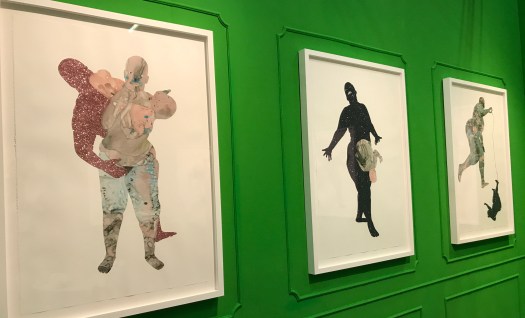
Nathalie Boutte FH Hawpine
Nathalie Boutté, F.H. Hawpine, 2019, Collage of Japanese paper, ink. Photo by Emily Casden, courtesy of Yossi Milo Gallery, New York.
Boutte Hawpine detail
Nathalie Boutté, F.H. Hawpine, 2019, detail. Photo by Emily Casden, courtesy of Yossi Milo Gallery, New York.

Nick Cave, dazzling as always, at Jack Shainman Gallery.

Nick Cave Hustle Coat
Nick Cave, Hustle Coat, 2018, mixed media including a trench coat, cast bronze hand, metal, costume jewelry, watches, chains, and vinyl. Photo by Emily Casden, courtesy of Jack Shainman Gallery, New York.

Mel Bochner. Still got it.

Mel Bochner Out of Your Fucking Mind
Mel Bochner, Are You Out of Your Fucking Mind?, 2018, etched and silvered glass. Photo by Emily Casden, courtesy of Two Palms, New York.

Hard to photograph, but beautiful assemblage by Lyle Ashton Harris at David Castillo Gallery.

Ashton Harris Black Hummingbird 1
Lyle Ashton Harris, Untitled (Black Hummingbird #1), 2019, unique assemblage (Ghanaian cloth, dye sublimation prints, ephemera). Photo by Emily Casden, courtesy of David Castillo Gallery, Miami Beach.

And lastly, love supporting the “young” galleries and their emerging to mid-career artists, such as Massinissa Selmani at Selma Feriani Gallery (Sidi Bou Said, Tunisia). Selmani takes images from the media and recreates them in new, drawn arrangements. The vast negative space of the drawings opens up the narrative to questioning and interpretation.

Massinissa Selmani No Plan is Foolproof
Massinissa Selmani, Untitled No.11, from the No Plan is Foolproof series, graphite and color pencil on paper. Photo by Emily Casden, courtesy of Selma Feriani Gallery, Sidi Bou Said, Tunisia.

Spring Art Fair Highlights: The ADAA Art Show

It’s the most wonderful time of the year! The spring art fairs are like Christmas for the art world—a belated and much-needed Christmas in March to pull us out of our winter blues. “Armory Week,” as it has come to be called, is a cultural smorgasbord of art fairs, parties, openings, panel talks, lectures, and performances that happen around the city. As you can imagine, there’s so much to pack in a few days that I do not have the time to write reviews in real-time (I can’t even get to all of the fairs and events I want to go to!), but I have, in a series of posts, covered some highlights and personal favorites that I saw at the venues I was able to cover. Check out my other posts for highlights from the Armory Show, Spring/Break and Scope.

The ADAA Art Show

This year the annual Art Show, hosted by the Art Dealers Association of America, kicked things off a week before “Armory week,” so as not to conflict with the grand art fair at Pier 92/94. At the Art Show you tend to find more modern art than the other fairs of Amory Week, as well as contemporary offerings. Many galleries continued their “correction” of representation, curating their booths to highlight works by women and artists of color. Overall the Art Show was, in my opinion, very strong: I enjoyed some singularly great works by established modernists, and discovered new contemporary artists. Below I share a sampling of both. Enjoy!

Dario Robleto Curious Confront Eternity
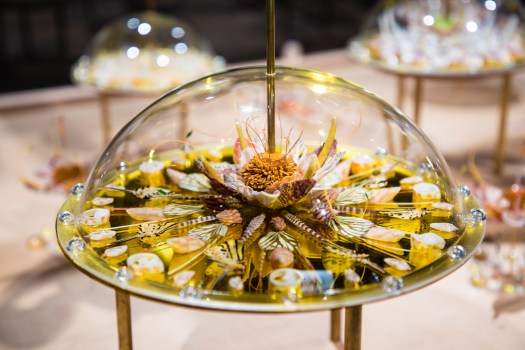
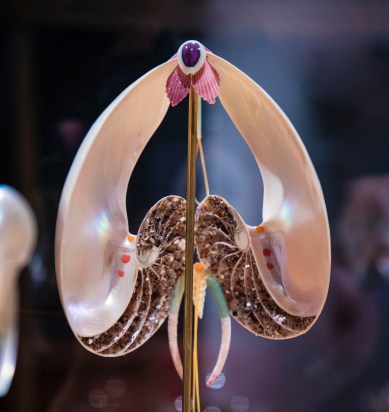
Dario Robleto, The Curious Confront Eternity, 2019. Cut paper, various cut and polished seashells, urchin spines, squilla claws, butterflies, colored powder pigments, plastic domes, prints on wood and paper, foam core, glue and frame. Photo by Emily Casden, courtesy of Inman Gallery, Houston, Texas

One of the great joys of the art fairs is to be exposed to galleries from around the country and world (it is also a tragedy—to discover a great gallery that isn’t a subway ride away!). In this case, I must find a good reason to go to Houston to see Inman Gallery and the work of Dario Robleto. I was drawn into Inman Gallery’s booth by Robleto’s intricate collages and large, ecological installation. I had a fascinating conversation with the gallery owner, Kerry Inman, about Robleto’s interest in Victorian traditions of collection and display, but my mind was truly blown when Kerry told me about Robleto’s artist residency with the SETI Institute. That’s right: the Search for Extra Terrestrial Intelligence Institute has an artist-in-residence program, in case we must communicate aesthetically with alien life. I loved this work so much I wrote a spotlight blog post on it—learn more about Dario’s work here.

Dario Robleto installation

Robleto_Inman_Sisyphean_detail_1

shell_install
Dario Robleto, Small Crafts on Sisyphean Seas, 2017-2018, detail. Image courtesy of Inman Gallery, Houston.

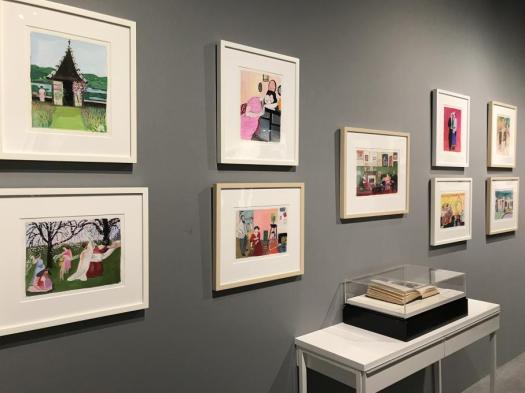
Other delightful contemporary work at the exhibition included a fantastic series of illustrations for a forthcoming edition of Gertrude Stein’s The Autobiography of Alice B. Toklas, by multi-disciplinary artist Maira Kalman at Julie Saul Gallery. Kalman doggedly went through archival material to base her gouaches on real photographs and people. The suite of thirty-five drawings lends a contemporary warmth and intimacy to the book, which should be coming out in 2020.

Kalman installation view
Maira Kalman, The Autobiography of Alice B. Toklas, by Gertrude Stein, 2019, installation view at the ADAA Art Show. Thirty-five gouaches on paper. Image courtesy of Julie Saul Gallery, New York.
Maira Kalman - Alice & Gertrude
Maira Kalman, Alice and Gertrude in living room with Cezanne painting, 2019
gouache on paper. Image courtesy of Julie Saul Gallery, New York.

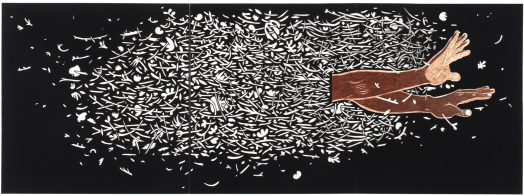
I would be remiss to not mention Susan Inglett Gallery, and the impressive cut-outs of artist William Villalongo. I have really enjoyed Susan’s recent shows, including her current Wilmer Wilson IV show, “Slim…you don’t got the juice” (catch it before it closes March 16). Villalongo’s large, velvety cut-outs are not only technically and graphically masterful, their message of the struggle and resilience of the black male body is palpable.

William Villalongo Zero Gravity 1 2018
William Villalongo, Zero Gravity 1, 2018, paper collage and cut velour paper. Image courtesy of William Villalongo.

Amid the modern art highlights at the fair, David Nolan Gallery had an exquisite exhibition of works by German artist George Grosz (1893-1959), focusing on his work during his New York years, 1933-1958. Grosz was one of the foremost German artists of the twentieth century; his modern, socio-politically charged works were among those singled out by Hitler as “degenerate,” and he fled to exile in the United States in 1933. A particularly fascinating contrast in the Art Show display are two watercolors that bookend his time in America: the first, a somber 1934 drawing called Wanderer, sympathetically depicting a cast-out Jew crossing a pond-like body of water; the second, a fiery 1956 composition, also called Wanderer, showing a blazing blue figure wading through a sun-soaked swamp. Who is the 1956 Wanderer? Is it an allegory, or perhaps Grosz himself, raging against the injustice of history?

Grosz The Wanderer 1934
George Grosz, The Wanderer, 1934, watercolor on paper. Image by Emily Casden, courtesy of David Nolan Gallery, New York.
Grosz The Wanderer 1956
George Grosz, The Wanderer, 1956, watercolor on paper. Image by Emily Casden, courtesy of David Nolan Gallery, New York.

I could go on and on about the great art I enjoyed at the fair, but alas, time does not allow for full discourse on each piece. Below are other great highlights of modern and contemporary works from the fair. If you have any interest, contact Avant-Garde and we can assist you with a purchase.

Lovely, playful collage by Jean Arp.

Jean Arp Head 1925
Jean Arp (1886-1966), Head; Object to Milk, 1925, painted collage, gold leaf and fabric on board. Image by Emily Casden, courtesy of James Goodman Gallery, Inc.

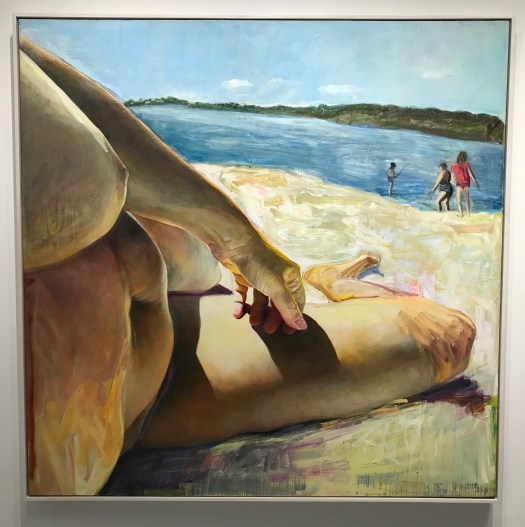
Classic Joan Semmel nude.

Joan Semmel Beachbody 1985
Joan Semmel, Beachbody, 1985, oil on canvas. Image by Emily Casden, courtesy of Alexander Gray & Associates, New York.

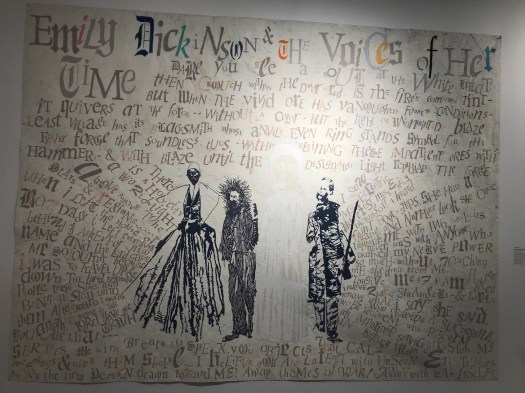
Part of an installation by Leslie Dill.

Lesley Dill Emily Dickinson 2017
Leslie Dill, Emily Dickinson and the Voices of Her Time, 2017. Oil on paper, thread on fabric-backed paper. The image depicts Emily Dickinson, Sojourner Truth, Walt Whitman and Thomas Wentworth Higginson. Image by Emily Casden, courtesy of Nohra Haime Gallery, New York.

Toby Mug by Judy Chicago. I would love to see this on the table at The Dinner Party!

Judy Chicago Toby Mug 2010
Judy Chicago, Two-Faced Toby Mug, 2010, multi-fired china paint on porcelain. Image by Emily Casden, courtesy of Salon 94, New York.

Check out this badass mama by Gaston Lachaise! I love the matting job, as if the figure is interacting with the mat. Really brings the work to life.

Gaston Lachaise Draped Figure
Gaston Lachaise (1882-1935), Draped Standing Figure, 1931-32, pencil on paper. Image by Emily Casden, courtesy of Debra Force Fine Art, New York.

Joan Bankemper’s whimsical and intricate porcelain constructions at Nancy Hoffman Gallery, New York.

Joan Bankemper Belmont Ceramic
Joan Bankemper, Belmont, 2018, ceramic. Image by Emily Casden, courtesy of Nancy Hoffman Gallery, New York.

Another Grosz. Man he’s good.

Grosz They Found Something
George Grosz (1893-1959), They Found Something, 1946, watercolor on paper. Image courtesy of David Nolan Gallery, New York.